

G2i is a specialist hiring platform built around speed and quality. It helps companies quickly find and hire remote developers.
In this guide, we'll look at how G2i works, its pricing, hiring process, developer vetting, strengths, and weaknesses. We'll also review customer feedback to see if G2i is worth using.
If G2i is not the right fit, we'll cover the top alternatives. A simple comparison list and decision guide will help founders and tech recruiters choose the right platform.
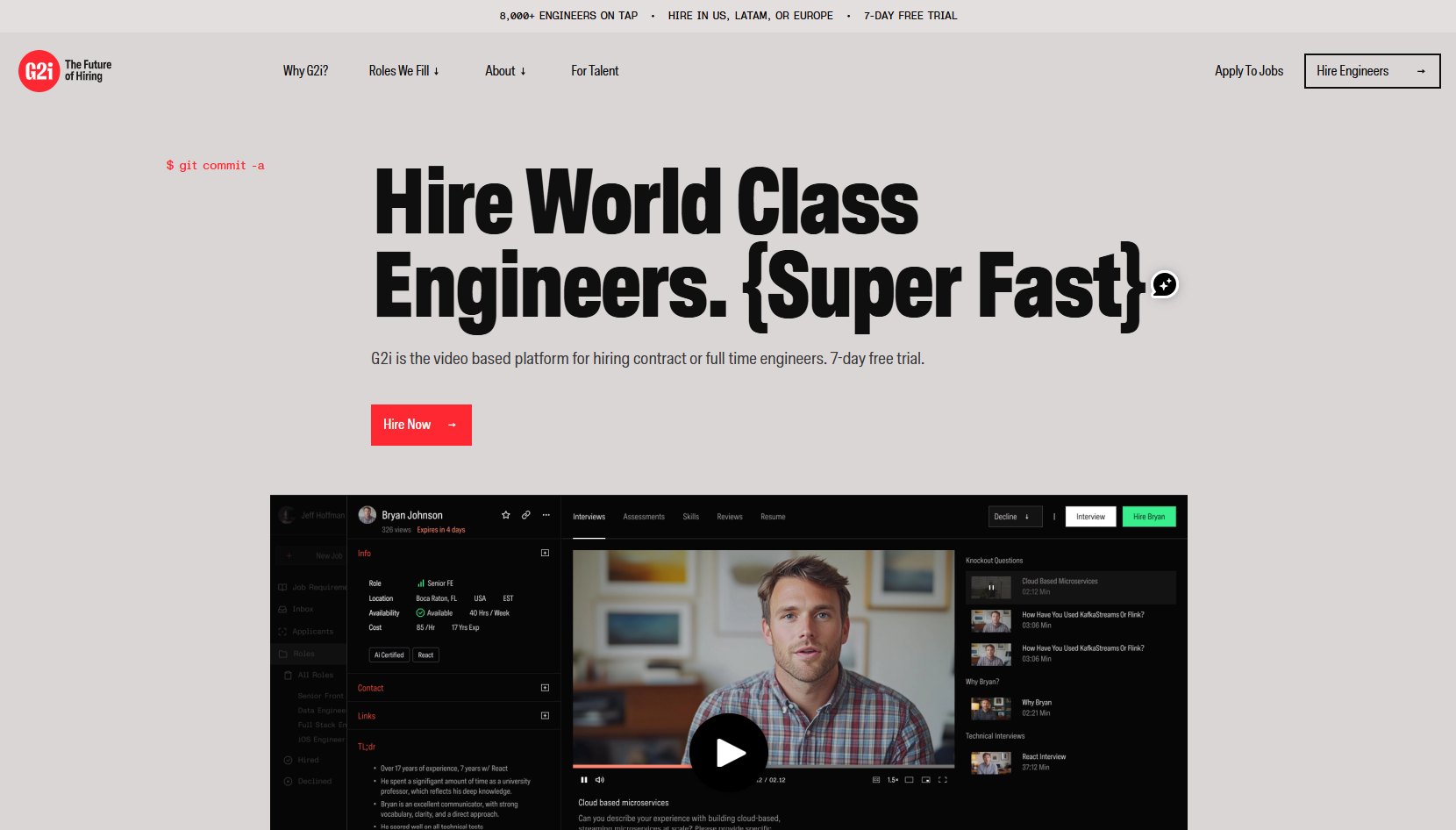
Founded in 2016 by Gabe Greenberg, G2i is a bootstrapped company based in Florida. It has grown without venture capital and has built a strong name in the React and React Native communities.
G2i focuses on JavaScript specialists, including React.js, React Native, Node.js, GraphQL, iOS, and Android developers. The company says it has a network of more than 8,000 engineers and has placed over 2,300 developers. It also reports more than $28 million paid to developers and over 500,000 hours of engineering work.
Its talent pool is spread across North America, Latin America, and Europe. This gives companies access to developers across several time zones.
G2i has also worked with companies such as Coinbase, Meta, Webflow, Automattic, Discover, Lattice, Shopmonkey, and Together AI.
G2i does not share its rate card directly on its website. It pre-negotiates rates with developers and presents clients with a single, all-inclusive hourly fee (developer rate plus G2i's markup). Based on what they say on their website, "the majority of our customers pay in the range of $60-140 per hour," varying by geography and desired seniority.
For full-time conversions and direct hires, G2i charges a success fee. Summaries of G2i's customer terms indicate the fee is $18,000 for staff-augmentation conversions. For direct hires or contractor engagement services, the fee is 20% of the new employee's salary (Clouddevs.com ). If you end staff-augmentation services for cause within seven days of the start date, G2i refunds 100% of the fees paid.
Separately, G2i's AI training and RLHF positions compensate engineers roughly $30 to $200 per hour based on experience level, with senior "AI interaction evaluator" roles assessing OpenAI Codex and Claude Code results at the higher $100-$200/hour range
G2i uses AI to match companies with developers, but it stays human-first. You work directly with the matching team, and they also handle compliance, global payments, insurance, laptop shipping, and background checks.
You can hire developers as contractors, contract-to-hire, or full-time employees. Many contract roles later turn into full-time jobs.
G2i's screening is video-based and meant to match real work. The process includes:
Candidates who pass join G2i's talent pool and get a profile ranked by performance. The key transparency difference is this: clients can watch the recorded technical interviews rather than seeing only a pass or fail score. G2i says it only shares engineers who meet 80% or more of a client's needs. For clients hiring 10 or more engineers, G2i builds a Custom Talent Pipeline using custom sourcing and assessment rules.
G2i holds a 4.1/5 "Great" rating on Trustpilot (49 reviews as of late August 2026), with a polarized distribution: 74% five-star and 20% one-star. Most positive reviews come from developers praising transparency, steady contract flow, on-time payments, and community. Client testimonials on G2i's own site are strongly positive but should be read as curated.
Positive, client side:
Positive, developer side:
Multiple long-tenured developers cite transparency and reliability. Rafael Lebre (on Trustpilot, in July of 2026) said: "I've been working with G2i for 6 years and I love it since day 1. The thing I value the most is their transparency."
Critical, client side:
A client identified as "DA" (UK) left a 3-star review (March 2026): "The candidate pool was subpar, especially considering the overpriced rates they quoted... the portal is actually very basic, broken on mobile, and only supports USD." G2i publicly replied that it was "actively working on improvements right now, including fixing issues on mobile."
Critical, developer side (a recurring pattern):
A 2-star reviewer (July 2026) described "a highly disorganised process," being "bombarded with automated LinkedIn messages," and being "completely ghosted for weeks after completing" an interview, plus a mismatched test ("applying for a front-end role but getting hit with a Python technical interview"). Another 1-star developer complained of being placed in a "talent pool" that felt like a way "to build a pool of pre-vetted candidates" without real placement. This impersonal/automated complaint pattern is the clearest recurring weakness in G2i's public reviews.
Let's look at the best alternatives to G2i.
Yep, that's us! We provide vetted React developers to tech companies to scale their software projects. We are 100% focused on React.js, making us the top choice for projects using this tech stack. The best part is you get to work with industry-tested engineers without the overhead of traditional hiring, while keeping 100% equity.
Best for: Startups looking to hire skilled React developers without bearing the costs of traditional hiring.
Toptal is a global network. It says it accepts only the top 3% of freelance applicants. It is known for a strict, multi-step vetting process across many fields. Rates often range from $60 to $200+ per hour. An undisclosed markup is included in the rate.
Toptal's FAQ says there is a flat monthly subscription fee of $79. This fee applies if you proceed with talent matching. It also offers a trial period of up to two weeks and requires a $500 refundable deposit to get started.
It is best for larger organizations that value deep vetting over predictable pricing.
Gun.io connects companies with vetted freelance and full-time developers. It uses algorithm-based screening and senior-developer technical interviews, and shows the full all-in rate upfront on candidate profiles. Freelance rates are usually $100 to $200+ per hour. Full-time placements cost 20% of the agreed first-year salary. Hires are usually made within 13 days after a company requests a candidate. It is better for longer-term contracts than quick, one-off tasks.
Lemon.io is a marketplace of pre-screened developers in Eastern Europe and Latin America, built for startups. It uses a four-step screening process with a 1.2% acceptance rate: a CV or resume check, English and soft-skills screening, a live technical interview, and onboarding. It includes 1,500+ developers, offers 24-hour matching and flexible month-to-month contracts, and includes a replacement guarantee. Senior rates often range from $28 to $87 per hour, with a senior median near $56 per hour and a "strong senior" median near $73 per hour. It is much cheaper than Toptal and offers 4 to 6 hours of daily US time overlap.
Arc.dev specializes in pre-vetted remote developers from a large global talent pool. It offers a free trial and more affordable rates, at about $60 to $110 per hour. Its vetting is often seen as less rigorous than boutique specialists, and hiring can also be a bit slower.
Here are the best alternatives for different use cases and scenarios.
G2i is a solid pick if you want deeply vetted React/React Native engineers, plus "radical transparency" like recorded technical interviews and flexible contract terms. Their focus on developer health also seems to build real loyalty, which helps keep their talent bench strong. That said, you won't see pricing until you hop on a call, the success fees can be high, and reviews suggest the experience can feel hit-or-miss, sometimes a bit impersonal or overly automated. It's also worth keeping an eye on their growing shift toward AI training/RLHF if your main goal is straightforward dev placement.
If you're a SaaS startup looking specifically for senior React specialists who can join as full-time, fully committed hires, matched within 48 hours at a clear $85/hour, ReactSquad is the more dialed-in option.
Ready to match with your dev? Schedule a call with us today!